

Unlike a hand tool you can replace in an afternoon, a car lift becomes part of your workshop’s structure. It anchors to the floor, dictates your bay layout, and serves every job for the next ten years. Buy the wrong one, and you will live with the consequences daily—too little capacity, a ceiling it will not fit under, or a lift that cannot reach the vehicles you actually service.
This guide breaks the decision into the five factors that matter most. Work through them in order, and you will narrow the market to the right car lift for your space, your fleet, and your budget.
1. Lift Type: Two-Post, Four-Post, or Scissor
Every buying decision starts here, because the type of lift determines what work you can do.
Two-post lifts raise the vehicle by its frame or lifting points, leaving the wheels hanging free. That open undercarriage is ideal for brake work, suspension repair, tire service, and general maintenance. They are the most common choice in professional repair shops, and the most versatile overall.
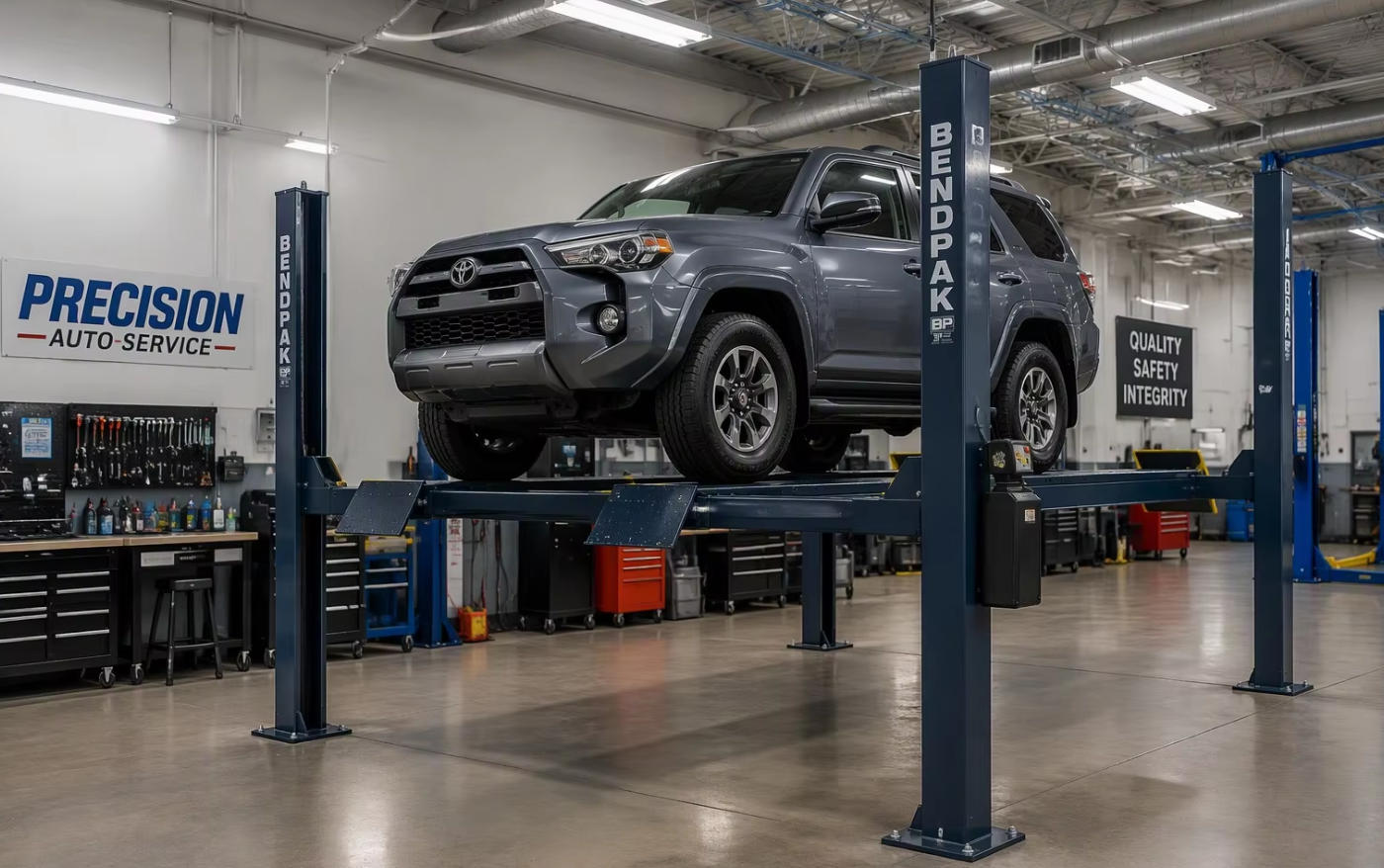
Four-post lifts drive the vehicle onto runways and raise it on all four wheels. Because nothing hangs free, they suit alignment work, storage, and heavier vehicles, but they restrict access to the wheels and take up more floor space.
Scissor lifts raise the vehicle on a compact platform. A mid-rise scissor car lift fits into low-ceiling garages and home workshops where a two-post lift cannot go, making it a favorite for detailing, tire work, and space-limited bays.
Choose the type by the work you do most, not by the one that looks most impressive.

2. Lifting Capacity and Vehicle Fit
Capacity is printed on every lift, but the right number depends on your vehicles—including the ones you might service next year.
- Passenger cars: 3 to 4 tons is usually ample
- SUVs and light trucks: 4 to 6 tons
- Vans and light commercial vehicles: 6 to 10 tons
- Heavy trucks and buses: 10 tons and above (usually a specialist lift)
Two rules protect you:
- Size for the heaviest vehicle, not the average one.
- Leave a safety margin. A lift working at 100% of its rating every day wears faster and leaves no room for uneven loading.
Also check the lift’s arm or runway reach against your longest wheelbase. A powerful car lift that cannot position its arms correctly is still the wrong lift.
3. Ceiling Height and Floor Space
This is where many buyers discover a problem after delivery. Measure before you choose.
- Two-post lifts typically need 11 to 13 feet of ceiling height for a full rise.
- Mid-rise scissor lifts need only 6 to 8 feet, which is why they dominate home garages.
- Four-post lifts need both height and a long floor footprint.
Do not forget the garage door. Even if the ceiling is tall enough, an open overhead door mechanism can block a raised vehicle. Measure with the door open, and account for the lift’s own height plus the tallest vehicle you plan to raise.
Floor space matters too. A car lift needs clearance on all sides for safe walking, tool access, and door opening.
4. Power Supply and Electrical Requirements
Lifts are typically driven by hydraulic power units, and those units need electricity.
- Single-phase (110V/220V): Common on home and light-commercial scissor and two-post lifts.
- Three-phase (380V/440V): Standard in industrial shops with heavy, high-cycle lifts.
Check three things before ordering: the voltage available at your site, the amperage the lift draws, and whether your panel has spare capacity. An electrician’s visit before purchase is far cheaper than rewiring after installation.
Air-operated or air-assist models are also available for workshops that already run compressed air and prefer pneumatic actuation.
5. Safety Systems: The Details That Protect People
A lift holds a vehicle above a person’s head. Safety is not a feature list—it is the foundation of the purchase.
- Mechanical safety locks: Engage automatically as the lift rises, so the load is held mechanically even if hydraulics fail. Inspect the number and spacing of lock positions.
- Synchronisation system: Cables or hydraulic equalisers keep both sides level. Poor synchronisation causes dangerous tilting.
- Overload and pressure protection: Relief valves and pressure switches prevent the system from operating beyond safe limits.
- Certification: Look for recognised standards (such as CE or ASME-style certification). Uncertified lifts are a false economy.
- Arm restraints or wheel stops: Prevent the vehicle from shifting once it is off the ground.
Any car lift worth buying makes these systems visible and serviceable, not hidden behind marketing claims.
Installation and Site Preparation
Budget for installation, not just the lift. Concrete thickness and strength are critical—most two-post and four-post lifts require a reinforced slab of specific depth, often 4 to 6 inches or more depending on the model. On insufficient concrete, anchors pull out and the lift becomes unsafe.
Plan for:
- Anchor bolts and their embedment depth
- A level floor area for the lift’s footprint
- Drainage or floor slope that will not interfere with the base
- Local building and electrical requirements
Professional installation is an investment in safety, warranty validity, and correct alignment.
Before you order, complete a simple site survey:
- Measure ceiling height with the garage door fully open.
- Confirm the concrete slab thickness and reinforcement—core-test if records are missing.
- Check the electrical panel for available voltage, amperage, and spare breakers.
- Map the lift footprint against door swings, walkways, and other equipment.
- Photograph the area and share it with the supplier for a second opinion.
A ten-minute survey prevents the most expensive mistakes in lift ownership: a unit that does not fit, cannot be anchored safely, or cannot be powered.
Maintenance and the Real Cost of Ownership
A car lift is a long-term asset, and its cost of ownership includes more than the purchase price.
- Monthly: Check cables or hydraulic lines for wear, confirm lock engagement, inspect for leaks.
- Annually: Have a qualified technician inspect structural welds, anchors, and the power unit.
- Consumables: Hydraulic fluid, cables, and lock components are the usual wear items.
A well-maintained lift can serve twenty years. A neglected one becomes a liability long before that.
Budgeting: What Actually Drives the Price
Two lifts with the same headline capacity can differ in price by several times. Understanding why helps you spend where it counts.
- Capacity and structure: Higher tonnage means thicker steel, larger cylinders, and a heavier base—genuinely more material, not just a bigger number.
- Lift type: Two-post and four-post units carry more steel and need more installation work than a compact scissor platform.
- Automation: Power-assisted arms, wireless controls, and self-locking systems add convenience, and cost.
- Certification and testing: Certified equipment reflects real safety testing, and that engineering is part of the price.
- Installation: Anchoring, electrical work, and site preparation can add a meaningful percentage to the project total.
The cheapest option is rarely the least expensive over ten years. Focus on the total cost of ownership: purchase, installation, maintenance, and the downtime you avoid.
Matching the Lift to Your Situation

FAQ: Frequently Asked Questions
- Q: What is the most common type of car lift?
- A: The two-post lift, because it offers the best balance of access, capacity, and versatility for general repair work.
- Q: How much ceiling height does a car lift need?
- A: A full-rise two-post lift generally needs 11 to 13 feet. A mid-rise scissor lift can work in a garage with only 6 to 8 feet of height.
- Q: Can I install a car lift in my home garage?
- A: Yes, provided the floor is thick, reinforced concrete and the ceiling is high enough. Mid-rise scissor lifts are the most home-friendly option.
- Q: What concrete thickness does a car lift require?
- A: It varies by model, but most two-post and four-post lifts require a reinforced slab of at least 4 to 6 inches, often more. Always follow the manufacturer’s specification.
- Q: How much does it cost to run a car lift?
- A: Running costs are modest—mainly electricity, hydraulic fluid, and periodic inspection. The larger investment is the initial purchase and installation.
- Q: Are used car lifts a good idea?
- A: Only with a thorough inspection of structure, cables, locks, and certification. Never buy a used lift with unknown history for use above people.
- Q: Do I need a certified car lift?
- A: Yes. Certification confirms the lift has passed recognised safety testing. Uncertified equipment puts operators at risk.
- Q: Can I install a lift myself?
- A: Some owners install smaller scissor platforms themselves, but full-rise two-post and four-post lifts should be installed by professionals. Correct anchoring and levelling are critical to both safety and warranty.
- Q: What voltage does a workshop lift need?
- A: Many light-commercial units run on single-phase 220V, while heavy, high-cycle lifts often require three-phase power. Check your panel before ordering.
Conclusion: Buy for the Next Ten Years
Choosing a car lift is a structural decision, not a shopping impulse. Match the type to your work, the capacity to your heaviest vehicle, the height to your building, the power to your supply, and the safety systems to the people who will work beneath it.
Get those five factors right, and your lift becomes the quiet backbone of the workshop for a decade or more. Choose Jingji Lifting for professional-grade lifting equipment designed to meet the demands of a real working garage.

